susy@tetheredsystem.com
+86 19952400441

Drone Cleaning System

What is a tethered drone cleaning system?
A tethered drone cleaning system uses a drone powered by a ground-based power station through a tether cable to perform exterior cleaning tasks. Unlike battery-only drones, it supports extended continuous operation without landing for battery changes, making it suitable for large-scale façade and industrial cleaning projects.
What are the main advantages of using a tethered drone for building cleaning?
The primary advantages are: continuous operation without battery interruption, stable power output for consistent cleaning performance, access to high or difficult-to-reach surfaces, and reduced dependence on scaffolding or manual rope access for large exterior areas.
Can a tethered drone cleaning system replace rope access or scaffolding?
In many high-rise and large-structure cleaning scenarios, it can significantly reduce or eliminate the need for rope access and scaffolding, lowering both cost and safety risk. The applicability depends on building height, surface type, local regulations, and required cleaning method.
What types of buildings and structures are suitable for drone cleaning?
Suitable applications include: glass curtain wall buildings, high-rise commercial facades, grain storage silos, industrial factory exteriors, warehouses, communication towers, and other large or hard-to-access exterior structures.
How long can a tethered drone cleaning system operate continuously?
Because power is supplied from the ground, the system is not limited by onboard battery capacity. Continuous operating duration depends on the ground power station capacity, thermal management, and working conditions — but is designed to far exceed the 20–30 minute limit of standard battery drones.
What is the difference between battery-powered drone cleaning and tethered drone cleaning?
Battery-powered drone cleaning is constrained by flight time, typically requiring landing every 20–30 minutes for battery swaps. Tethered drone cleaning uses continuous ground-supplied power, removing this constraint and enabling longer, more consistent cleaning cycles — especially important for large-scale or repetitive operations.
What components make up a complete drone cleaning system?
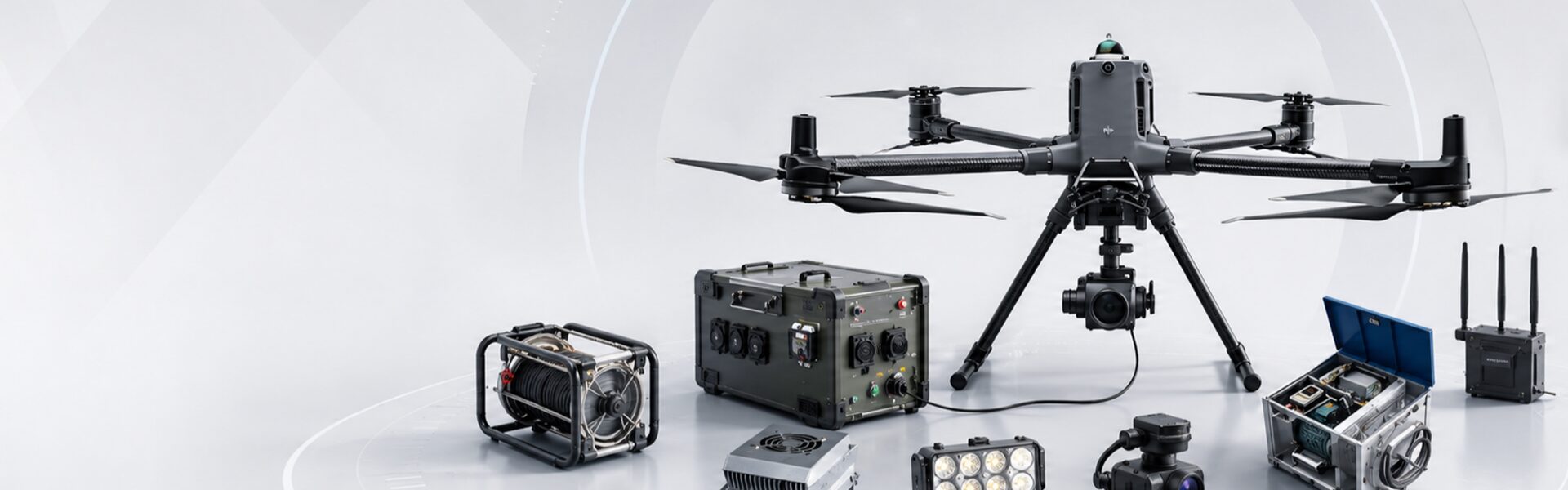
A complete tethered drone cleaning system typically includes: a ground power station, a tether cable (often with Kevlar reinforcement for strength and safety), an airborne power module, a compatible drone platform, and a cleaning payload such as a high-pressure nozzle and pump system.
What payload capacity is needed for drone-based high-pressure cleaning?
This depends on the pump type, nozzle setup, and water supply method. For most façade cleaning applications, the airborne payload — including the pump, nozzle, and associated hardware — typically requires a drone platform with sufficient lift capacity. We can advise on payload matching based on your specific cleaning requirement.
Is drone cleaning suitable for glass façades?
Yes. Glass curtain walls are one of the most common applications for drone cleaning systems, as they present challenges for traditional rope access methods. The key considerations are nozzle type, water pressure, proximity control, and surface protection.
Can a drone cleaning system be used on industrial facilities and grain silos?
Yes. Large curved or vertical surfaces such as grain silos and industrial facility exteriors are well-suited for tethered drone cleaning, particularly where scaffolding is impractical and rope access is hazardous.
What industries are adopting drone cleaning systems?
Industries currently evaluating or deploying drone cleaning systems include: building façade maintenance contractors, property management companies, industrial facility operators, infrastructure service providers, utility companies, and high-altitude cleaning specialists.
What should I evaluate before choosing a drone cleaning system supplier?
Key criteria include: whether the supplier provides a complete system or only components, technical documentation quality, compatibility with your drone platform, payload customization capability, after-sales support, and relevant project experience.
Can the cleaning system be customized for different buildings or cleaning methods?
Yes. System configuration — including tether length, payload type, nozzle setup, and power parameters — can be discussed based on the target structure, cleaning method, and operating environment.
Is a tethered drone cleaning system safer than traditional high-altitude cleaning methods?
In many scenarios, drone-based cleaning reduces direct human exposure to high-risk positions. The actual safety advantage depends on project design, operator training, local regulations, and site conditions.
Can tethered drone cleaning systems work at night or in low-light conditions?
With appropriate lighting payloads or onboard lighting, certain cleaning operations may be possible in low-light environments. Specific application suitability should be evaluated based on site conditions and regulatory requirements.
What wind conditions can a tethered drone cleaning system handle?
Wind resistance depends on the drone platform, payload weight, and tether tension management. For cleaning operations, moderate and stable wind conditions are generally preferred to maintain positioning accuracy and cleaning consistency.
How does the tether cable work in a drone cleaning system?
The tether cable serves both as the power transmission line and a physical safety constraint that limits the drone's horizontal and vertical range. Cables are typically reinforced — often with Kevlar fiber — to handle the combined stress of power transmission and mechanical tension during flight.
Can drone cleaning systems be used for solar panel cleaning?
Certain configurations may be applicable for solar panel cleaning, depending on the panel layout, mounting height, surface sensitivity, and required cleaning method. This should be evaluated case by case.
How do I get started with selecting a drone cleaning system for my project?
Start by defining your target structure (height, surface type, access constraints), required operating duration, existing drone platform (if any), and cleaning method. With this information, a supplier can help you identify the right system configuration and payload matching.

Drone Payloads and Tethered Systems

What is a drone payload in industrial UAV applications?
A drone payload is the functional equipment carried by the UAV to perform a specific task — such as cleaning, firefighting, aerial lighting, monitoring, or communication relay. In industrial applications, the payload is often the primary value driver of the entire drone system.
What types of drone payloads does Kitefly Tethered provide?
We focus on industrial-grade mission payloads including: high-pressure cleaning systems, aerial firefighting modules, high-lumen lighting arrays, communication relay equipment, tethered display screens, and monitoring-related solutions — all designed for use with tethered power systems.
What is the difference between a standard drone accessory and an industrial drone payload?
A standard drone accessory is typically a basic add-on such as a camera mount or propeller guard. An industrial drone payload is a purpose-built system designed to perform a defined operational task — with specific power requirements, weight budgets, mounting interfaces, and control integration.
How do I choose the right drone payload for my application?
Payload selection depends on: task type, required output (pressure, lumens, communication range, etc.), available drone lift capacity, power supply method, mounting interface, and operating environment. We can help match payload options to your specific application and drone platform.
Can your drone payloads be used with tethered power systems for longer operations?
Yes. Our payload solutions are specifically designed around tethered power architecture, which removes battery constraints and allows higher-output payloads to operate continuously — something not practical with standard battery-powered drones.
Are your payloads compatible with flagship platforms like DJI M350, M400, and FC100?
Selected payload solutions are compatible with established industrial UAV platforms. Compatibility depends on the mounting structure, power interface, and application scenario. We can advise based on your platform and task requirements.
Can payloads be customized for specific project requirements?
Yes. For project-based customers, we support discussion of customized payload configuration, power matching, mounting design, and control integration based on the target application.
What is a tethered drone firefighting system?
A tethered drone firefighting system mounts a firefighting module — such as a dry powder or water mist dispenser — on a drone powered by a continuous tethered power supply. This allows the drone to maintain position and operate the firefighting payload for extended periods without landing for battery changes.
What is a tethered drone lighting system used for?
Tethered drone lighting systems are used for nighttime aerial illumination in applications such as emergency response, infrastructure inspection, outdoor events, construction sites, and military or security operations. Continuous tethered power allows high-lumen output over extended periods.
What is a tethered drone communication relay system?
A tethered drone communication relay mounts a relay device on a hovering drone to extend the range of ground-based communication networks. Because the drone remains stationary and continuously powered, it can serve as a persistent aerial relay point for extended operations.
What is a tethered drone monitoring system?
A tethered drone monitoring system uses a continuously powered, hovering drone to provide persistent aerial surveillance or monitoring coverage over a fixed area. It is used in applications such as perimeter security, border monitoring, infrastructure inspection, and event oversight.
What industries use industrial drone payloads with tethered power systems?
Key industries include: building maintenance and cleaning, emergency response and firefighting, public safety and security, infrastructure inspection, military and border operations, utility and energy companies, and industrial facility management.
Why is tethered power important for industrial drone payloads?
Many high-value industrial payloads — such as high-pressure pumps, high-lumen lighting arrays, and communication relay equipment — require sustained power levels that exceed what onboard batteries can reliably deliver for extended operations. Tethered power removes this constraint.
How do I specify a tethered drone system for a new project?
Key parameters to define include: operating height, required continuous duration, mission payload type and power requirement, drone platform (existing or new), tether cable length, ground power availability, and any site-specific environmental constraints.

Copyright © 2025 Nanjing Weize Chuangli Electronic Technology Co., Ltd. All Rights Reserved.

Contact Us

Request Inquery