
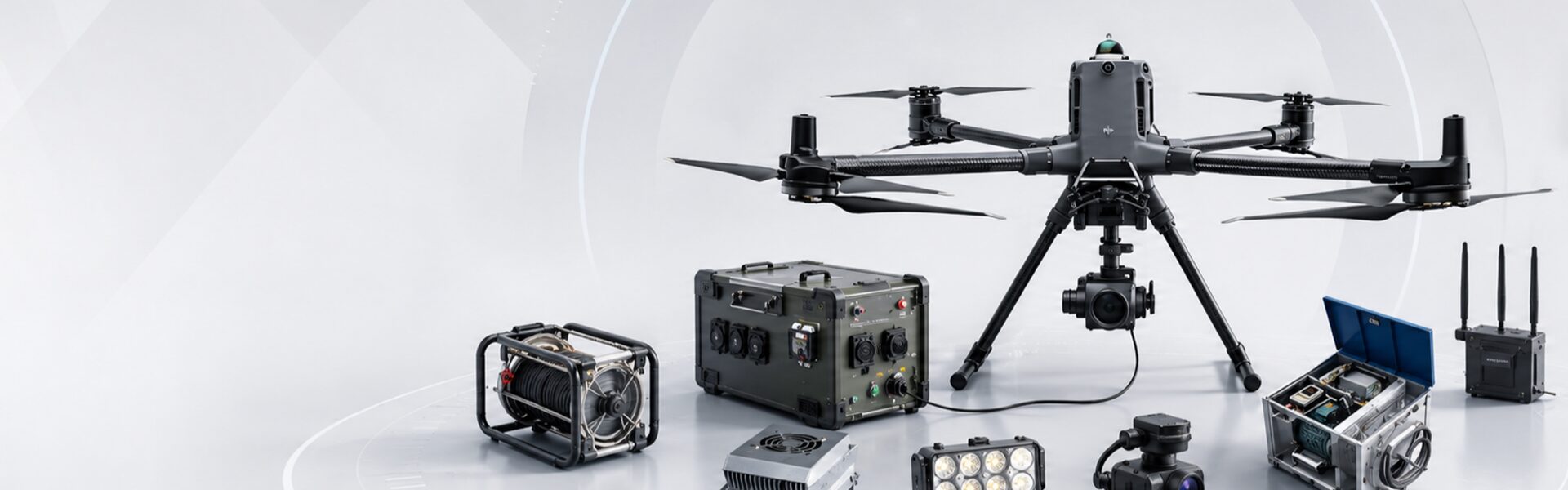
When a drone platform moves into the 200 kg payload class, the discussion changes completely. The question is no longer whether the aircraft can simply lift a camera, a sensor, or a lightweight tool. The real question becomes what kinds of industrial work can now be completed in the air with fewer compromises. For high-rise facade cleaning and large-scale firefighting, FC200 opens a new category of operation: carrying larger functional payloads, handling more complex work packages, and supporting task designs that were previously too heavy, too unstable, or too fragmented for conventional UAV platforms.
This matters because both cleaning and firefighting are system-level jobs. A useful aircraft is not defined only by its ability to fly. It must carry the tools that actually solve the problem: spray assemblies, hose guidance devices, fluid delivery structures, stabilizing components, nozzles, cameras, lighting, thermal observation equipment, communication hardware, and safety redundancies. In these applications, payload capacity is not just a number on a specification sheet. It directly determines how much work can be done per cycle and how much equipment can be integrated into one airborne platform.
A 200 kg payload class makes it possible to think in terms of complete task modules rather than isolated accessories. For facade cleaning, that can mean stronger spray structures, more stable fluid delivery arrangements, better anti-swing design, and a payload layout that supports actual building-side work instead of a lab demonstration. For firefighting, it can mean carrying heavier suppression assemblies, larger-capacity delivery components, or mission combinations that include both fire attack and real-time scene observation.
In practical terms, higher payload capacity improves integration freedom. Engineers have more room to balance weight, stiffness, reach, safety margin, and auxiliary functions. Operators gain more options when selecting nozzles, hoses, pumps, tanks, thermal sensors, or communication devices. That flexibility is what turns a powerful aircraft into a useful industrial platform.
High-rise cleaning is often misunderstood as a simple spraying task. In reality, it is a precision application that requires controlled standoff distance, stable hovering near vertical surfaces, consistent spray coverage, and reliable carriage of cleaning components. A larger payload platform changes the equation because it can support more robust cleaning structures and maintain better system stability when the aircraft is working close to the facade.
For tall building maintenance teams, the benefit is not only higher lifting capacity but also better operational design. A heavier platform can support wider or more purpose-built cleaning tools, stronger mounting assemblies, better cable or hose management, and additional sensing equipment for obstacle awareness and position verification. That translates into more practical deployment on glass curtain walls, industrial facades, stadium exteriors, and other large vertical surfaces where lightweight drone setups often become inefficient or overly sensitive to disturbance.
Fire missions place a different kind of pressure on an aircraft. Payload matters, but so do heat exposure, airflow disturbance, response speed, target access, and the ability to deliver meaningful firefighting effect rather than symbolic aerial presence. In this context, a 200 kg payload platform allows integrators to think about real suppression-oriented configurations, not just lightweight demonstration packages.
That can include heavier nozzle assemblies, larger flow-supporting structures, more capable thermal observation payloads, stronger communication relay equipment, or multi-function mission setups where one aircraft supports suppression while also contributing to scene awareness. For industrial fires, warehouse incidents, petrochemical facilities, forest-edge structures, and large-area emergency response, that extra carrying margin can significantly expand the types of payload architecture that are feasible.
In both cleaning and firefighting, operators usually lose efficiency because the aircraft cannot carry everything the mission actually needs at the same time. Once payload is limited, teams are forced into trade-offs: smaller tools, lower flow rate, simplified structures, reduced sensing, or additional sorties just to compensate for missing onboard capability. A higher payload platform helps reduce those compromises.
That does not mean every mission should maximize weight. It means teams can design around performance and safety first, instead of being boxed in by narrow payload margins. For commercial users, this can improve workflow continuity, reduce repeated deployment steps, and make system integration more realistic for demanding job sites.
A heavy-lift platform creates opportunity, but real project value still depends on the complete solution around it. Cleaning effectiveness depends on the relationship between aircraft stability, spray structure, fluid system, control logic, and jobsite workflow. Firefighting effectiveness depends on suppression method, payload interface design, thermal awareness, and coordination with ground teams. FC200 should be viewed as a carrier platform within a mission-specific system, not as a standalone answer.
For projects that require extended hovering or repetitive vertical work, operators may also evaluate supporting ground-based architectures, liquid supply arrangements, or other infrastructure that complements the airframe. The bigger the aircraft becomes, the more important total system engineering becomes.
The most promising use cases are not generic drone demonstrations. They are repeatable industrial tasks with clear operational pain points. In facade cleaning, that includes large commercial buildings, hotel exteriors, glass curtain walls, airport structures, stadium envelopes, and industrial plants where manual access is slow, risky, or expensive. In firefighting, it includes scenarios where height, smoke, heat, or access restrictions make it difficult for ground teams to reach the right position quickly.
This is why FC200 is important from an application perspective. Its 200 kg payload is not just about lifting more weight. It is about enabling more complete airborne work packages, supporting more serious engineering integration, and pushing industrial drone operations closer to real task replacement rather than partial assistance.
Q: Can FC200 be used for high-rise building facade cleaning?
A: Yes. The platform is highly relevant for facade cleaning because a larger payload class allows the integration of more robust spray structures, stronger mounting systems, and additional sensors or support components needed for real building-side operations.
Q: Why does a 200 kg payload matter in aerial firefighting?
A: Because firefighting payloads are rarely limited to a single nozzle. A meaningful system may also require suppression hardware, delivery structures, thermal observation equipment, communication devices, and safety margin. A 200 kg class platform offers much more room for practical integration.
Q: Is FC200 suitable only for firefighting, or also for industrial cleaning work?
A: It is suitable for both. The value of FC200 lies in supporting application-specific payload systems. In cleaning, that means better tool integration and more stable jobsite performance. In firefighting, that means stronger mission payload combinations and more serious emergency-response capability.
Q: What types of projects benefit most from this class of heavy-lift UAV?
A: The biggest benefits usually appear in projects with demanding payload architecture, difficult access, or repetitive high-altitude work. Typical examples include glass facade cleaning, industrial exterior maintenance, large-site emergency response, and elevated fire suppression support.
Q: Does higher payload automatically guarantee better field performance?
A: No. Payload capacity creates room for better solutions, but field performance still depends on system engineering, payload design, flight control strategy, safety planning, and the match between the aircraft and the actual task.
Copyright © 2025 Nanjing Weize Chuangli Electronic Technology Co., Ltd. All Rights Reserved. privacy policy