
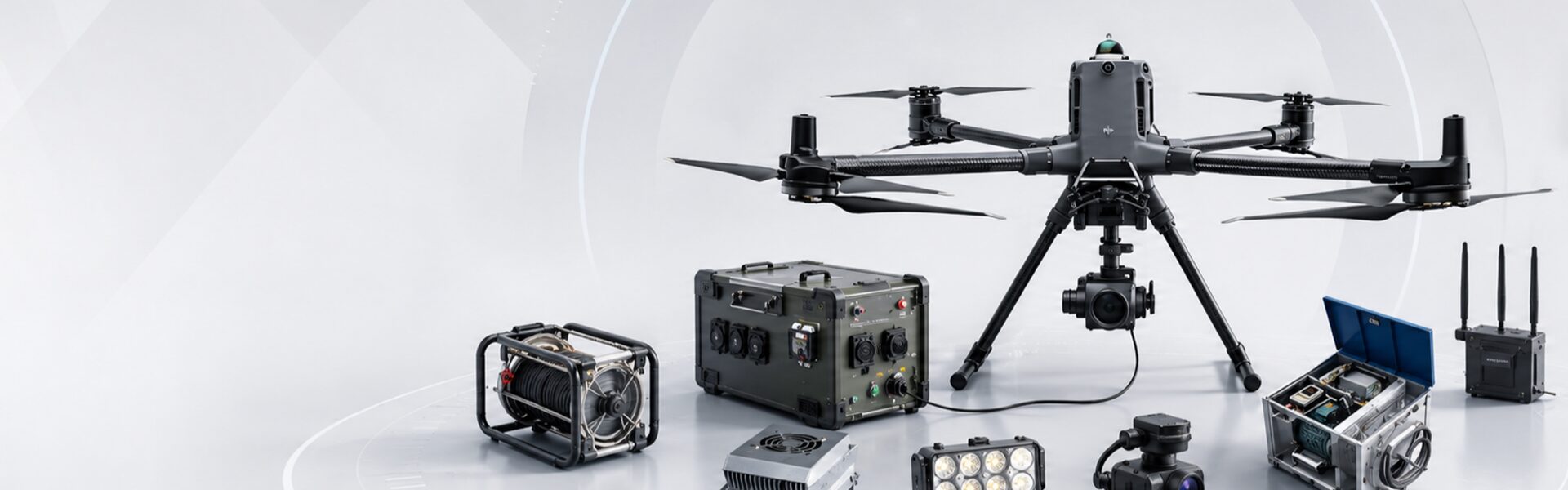
Cable tangling, time-consuming manual deployment and retrieval, inconsistent cable tension, equipment collisions, and unexpected operational interruptions—these are common cable management challenges in industrial unmanned systems. A fully automatic cable winch provides a single, integrated solution. Powered by constant tension control, automatic level winding, overload self-locking, and a rugged waterproof and dustproof design, it supports five key industries: low-altitude economy, wind energy, EOD, underwater operations, and aerial payload delivery. By enabling unattended, synchronized cable deployment and retrieval, the system significantly improves both operational safety and efficiency.
Let’s explore how an automatic cable winch delivers value across five real-world applications.
With conventional manual cable handling, tether cables often drag across the ground or become entangled in the drone’s propellers. Under windy conditions, loose cables can pull against the aircraft, reducing flight stability. Traditional manual winches cannot synchronize cable deployment and retrieval with the UAV’s ascent and descent, making long-duration operations labor-intensive. In addition, high-voltage hybrid power-and-fiber tether cables are susceptible to damage caused by uneven cable tension.
Constant tension control
The winch automatically pays out cable as the UAV ascends and actively retrieves it during descent, maintaining consistent cable tension throughout the flight. This prevents ground dragging and minimizes the risk of propeller entanglement, while ensuring stable operation in winds of up to Beaufort Force 6–7.
Continuous power supply for extended missions
Compatible with tethered power systems ranging from 1.5 kW to 40 kW, the winch supports 100–300 m hybrid power-and-fiber tether cables, providing continuous ground power for uninterrupted UAV operations. This enables true 24/7 hovering for applications such as emergency communications, aerial surveillance, temporary lighting, and live event broadcasting.
Comprehensive safety protection
Integrated cable length monitoring, automatic overload and short-circuit protection, and a power-loss self-locking mechanism protect both the cable and aircraft. A manual emergency crank provides an additional layer of operational security under emergency conditions.
Portable all-in-one design
Equipped with wheels and carrying handles, the system can be transported by vehicle or carried by a single operator. One-touch automatic cable retrieval allows fast packing and rapid redeployment between missions.


Modern wind turbines commonly exceed 100 meters in height, making manual blade inspection both hazardous and inefficient. When UAVs carry copper mesh probes for lightning protection testing, manually managed test cables can become tangled or snagged during flight, causing unstable cable tension, unreliable grounding resistance measurements, and longer inspection cycles.
Precision synchronized cable deployment and retrieval
The automatic cable winch deploys the test cable in sync with the UAV during ascent and automatically retrieves it during descent. Constant tension control keeps the copper mesh securely in contact with the blade tip, ensuring reliable collection of lightning protection continuity and grounding resistance data.
Lightweight UAV integration
Designed specifically for industrial UAV platforms such as the DJI Matrice 300 RTK and Matrice 350 RTK, the compact winch minimizes additional payload while maintaining stable flight performance.
Optimized cable protection
An automatic level-wind mechanism evenly spools the testing cable, reducing abrasion, preventing cable overlap, and extending the service life of consumable cables.
Built for harsh outdoor environments
The winch is engineered for demanding field conditions with excellent resistance to dust and extreme temperatures, ensuring reliable operation in both onshore and offshore wind farms.

In hazardous environments with heavy debris and strong electromagnetic interference (EMI), wireless communication can become unstable or fail entirely. As an EOD robot moves, manually managed fiber optic cables can accumulate, become tangled, or suffer abrasion from sharp obstacles. These issues restrict the robot’s mobility, increase operational risk, and slow response times due to manual cable management.
Synchronized cable deployment and retrieval
An integrated encoder continuously synchronizes cable deployment and retrieval with the robot’s travel speed. The winch automatically deploys cable as the robot moves forward and retrieves it during reverse movement, eliminating excess cable buildup and allowing smooth navigation through debris, confined spaces, and narrow tunnels.
Dedicated fiber optic slip ring
A high-performance fiber optic slip ring provides lossless transmission of HD video and control signals while isolating electromagnetic interference. This ensures stable, uninterrupted communication in environments with strong EMI, as well as in flammable and explosive areas.
Overload protection with automatic shutdown
Adjustable cable tension thresholds continuously monitor cable load. If the cable becomes snagged on sharp objects or other obstacles, the system automatically stops to prevent fiber breakage and communication loss.
Quick-release modular design
The modular mounting system allows fast installation on a wide range of tracked EOD robots, enabling a single winch to support multiple platforms and mission types.
An ROV’s umbilical cable combines power transmission, fiber optic communication, and control signals in a single cable. Manual cable handling can easily lead to twisting, kinking, and abrasion. Meanwhile, waves and underwater currents create sudden changes in cable tension that may damage the cable core and limit the efficiency and endurance of deep-water operations.
Fully waterproof and corrosion-resistant construction
Manufactured from 316 stainless steel and equipped with waterproof sealed slip rings, the winch provides outstanding resistance to salt spray and marine corrosion. It is designed for long-term deployment on marine vessels and supports deep-water operations at depths of several hundred meters.
Adaptive underwater tension control
The system automatically adjusts cable tension according to the ROV’s diving, ascending, and maneuvering conditions. Constant tension control prevents excessive pulling that could affect vehicle stability while avoiding slack cable that may snag on reefs or underwater structures.
Automatic level winding with cable length monitoring
The automatic level-wind mechanism evenly spools the umbilical cable while the integrated cable length counter displays deployment depth in real time, enabling accurate monitoring and recording of the inspection range.
Remote electric control integration
The winch supports remote integration with surface control stations. When deployed with an unmanned surface vessel (USV), it enables automated underwater inspection, mapping, and sampling operations.

Traditional lifting ropes provide little or no control over descent speed, increasing the risk of payload impact during delivery. During flight, suspended ropes can swing excessively, affecting the UAV’s stability. After payload release, loose rope must be manually retrieved, making post-mission recovery inefficient and time-consuming.
Constant-speed descent control
A servo-driven braking system precisely controls the payload’s descent speed, enabling smooth and controlled lowering of payloads weighing 30–200 kg while minimizing the risk of impact damage. In the event of a power failure, the self-locking mechanism immediately secures the load to prevent accidental drops.
In-flight cable locking
During transit, the winch automatically maintains cable tension, keeping the payload close to the aircraft and minimizing swinging for improved flight stability.
One-touch automatic cable retrieval
Once the payload has been delivered, the winch automatically retrieves the remaining cable at the touch of a button, eliminating the need for manual rope collection after high-altitude operations.
Compact airborne design
The lightweight winch can be mounted directly beneath the UAV, making it suitable for emergency supply delivery, high-altitude equipment lifting, and firefighting rescue operations.

From tethered UAV operations and wind turbine inspection to EOD robots, ROVs, and aerial payload delivery, a single automatic cable winch provides a reliable solution for cable management across five demanding industrial sectors.
Every system incorporates five core technologies:
The winch can be fully customized to meet specific application requirements, including power capacity, cable length, protection rating, and installation configuration. It is compatible with a wide range of unmanned platforms, including UAVs, ground robots, and remotely operated underwater vehicles (ROVs), delivering safer, more efficient, and more reliable cable management for mission-critical operations.
Copyright © 2025 Nanjing Weize Chuangli Electronic Technology Co., Ltd. All Rights Reserved. privacy policy